

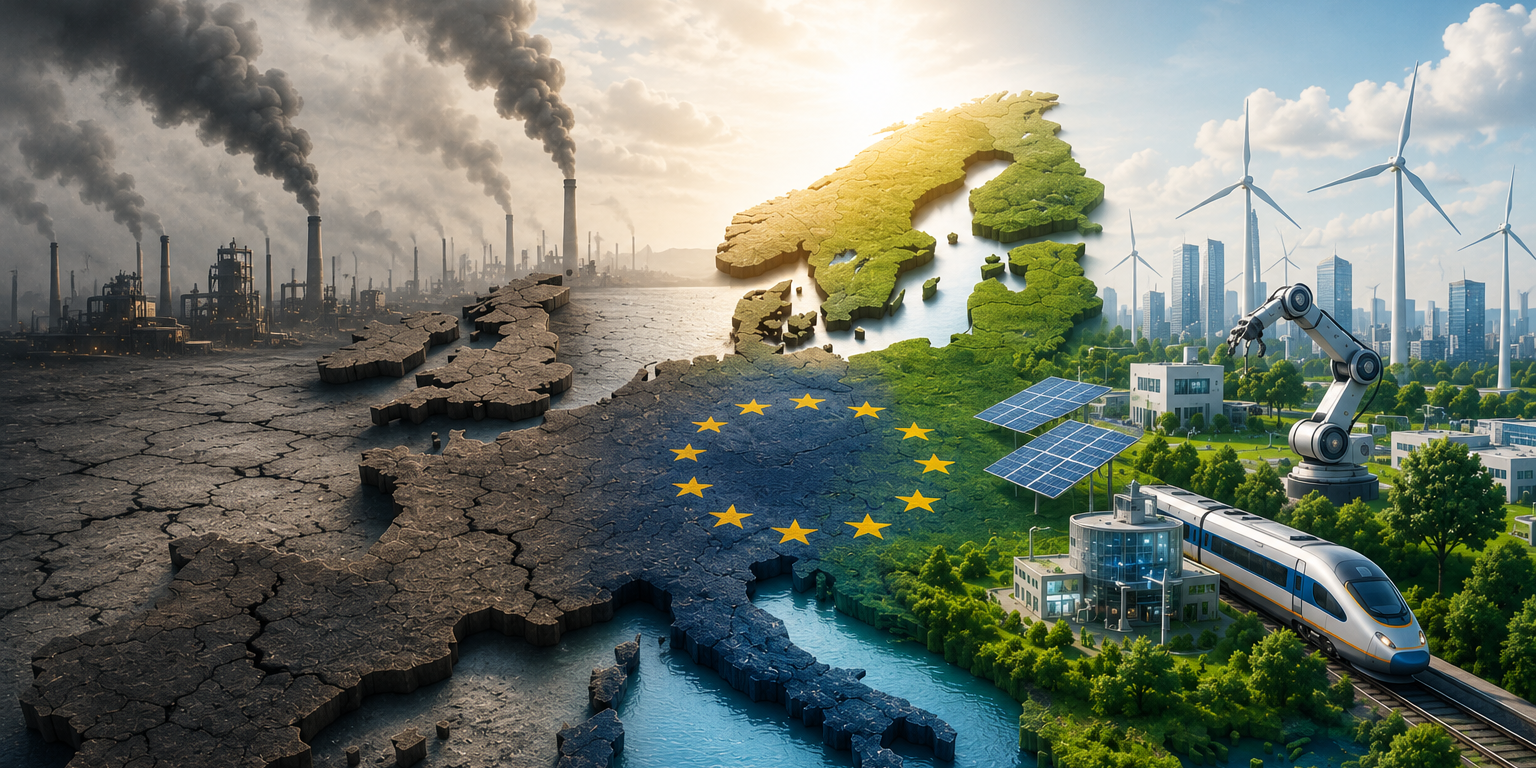
Between Scylla and Charybdis
The timing could hardly be better: just as Christopher Nolan brings one of the defining epics of Western civilization back to the cinema, the EU finds itself caught between its own Scylla and Charybdis. The Union is under pressure on every side — lagging in the AI race, struggling to hold its ground in world trade. The Draghi report, commissioned by Ursula von der Leyen in 2024, was meant to bolster European competitiveness. Yet Europe now faces a threat on two fronts: a trade war waged by the United States and the state-backed industrial policy of Beijing. Truly caught between a rock and a hard place.
The Dragon in the Room
The dragon in the room is, of course, China. In 2025 the EU’s goods trade deficit with China reached €359.9 billion — almost €1 billion every single day — up from €312.2 billion in 2024, though still short of the record €397.3 billion set in 2022. Beijing has put all its eggs in one basket: industrial policy. Made in China 2025 ranks among the most successful state-backed strategies in history, a coordinated deployment of interlocking policy tools designed to advance Chinese manufacturing and push the country up the value chain in key industries. It has largely worked — helped along by Western companies that chose short-term gains over long-term strategy. The most compelling account comes from Patrick McGee, whose book Apple in China masterfully traces how Apple built up Chinese manufacturing know-how and, by neglecting the long-term strategic picture, nurtured its own rivals on the mainland, Huawei among them. Today Apple is trapped, dependent on the goodwill of the CCP to keep its own operations running.
Chinese Subsidies
Subsidies are the second pillar. China deploys them strategically, generating ferocious competitive pressure in key sectors and conditions in which no company actually turns a profit. For Beijing, that hardly matters. As long as one or two firms survive, foreign competitors are driven from the market, and China climbs the value chain, the spending counts as a sound investment. The Chinese have a word for it: neijuan, or involution — a race to the bottom. The term spilled over from social media, where young netizens used it to capture the crushing pressure of the college entrance exam, the gaokao, and the “996” schedule (9 a.m. to 9 p.m., six days a week). It is a fitting name for the grind, in an era of high youth unemployment and weak domestic demand. In business, this involution is stoked further by local governments, which compete with subsidies of their own for companies and market share — think of heavily backed regional carmakers such as Changan (Chongqing) and BAIC (Beijing).
The American Response Makes Europe More Vulnerable
Washington has answered its own deficit by slamming the door on Chinese goods, wielding Trump’s favourite trade-war instrument: tariffs. But with domestic demand stubbornly weak, Chinese firms depend on exports to survive. Southeast Asia cannot absorb such a volume, so the surplus pours, above all, into the European market. For European industry, this is bad news. There is no level playing field in China — Europe’s firms are being squeezed out by unfair practices, subsidies, and political design, all spelled out in the latest five-year plan. And as Apple shows, the West helped build the very competition it now faces. European companies struggle to hold their ground not only in China but, increasingly, on global markets, as Chinese rivals seize the lead in entire industries and capture ever more share in third countries.
The Role of Ideology in the CCP
This lopsided relationship is set to grow more lopsided still — if Beijing has its way. China is steadily walling its own market off from world trade, driven by the Party’s determination to become independent of the outside world. The lesson was first drawn from the sanctions that followed the Tiananmen Square massacre of 1989, and it has been reinforced by the war in Ukraine and the Western response to Russia. Beijing wants to be ready for a military or hybrid move against Taiwan — a scenario that grows no less likely as Xi Jinping ages. Since taking power in 2012, Xi has driven a dramatic shift in foreign policy, with industrial policy as one of its central pillars and a single goal in view: to make China the world’s dominant power.
In his excellent book On Xi Jinping, the former Australian prime minister Kevin Rudd argues that Xi has returned ideology to the heart of the CCP, forging a new “Marxist-Leninist nationalism” that Beijing enshrines as “Xi Jinping Thought for the New Era.” Ideology was never absent, but Xi has pulled Chinese politics toward the “Leninist left,” reasserting the leader’s authority over the Party’s collective leadership, unwinding Deng Xiaoping’s “liberal reforms,” and restoring a Mao-like grip. Since 2017 he has also shifted the center of gravity of economic policy to the “Marxist left,” asserting the primacy of state planning over markets and of state-owned enterprises over “private firms” — if any firm in China can truly be called private, that is a debate of its own — while steering foreign policy to the “nationalist right.” Xi is a calculated risk-taker, and his ambition is nothing less than to remake the global order, promoting ever more aggressively an alternative to Western liberal democracy through his four signature initiatives: the Belt and Road Initiative (BRI) and the Global Development, Global Security, and Global Civilization Initiatives.
The EU needs to act now
Europe, then, must act — to shield its market from Chinese industrial policy and the coming China Shock 2.0. Beijing’s strategy is deliberate: to target the very industries in which European nations, Germany above all, once led. In Germany alone, according to a study by the German Economic Institute (Institut der deutschen Wirtschaft, IW), more than 400,000 jobs were lost between 2020 and 2026 to Chinese industrial policy. For twenty years Europe tried to build a level playing field in China. Beijing stalled, deflected, and offered just enough — minor concessions to keep hope alive, the carrot of a 1.4-billion-strong market with a growing middle class dangled before Western firms — until those firms had handed over enough know-how to become expendable. Now they are being squeezed out, methodically and by design. If we mean to save our industries — and this is also a question of democratic resilience, for the first China shock in the United States can be traced to the rise of right-wing populism — we must find real answers to the China Shock 2.0.
 Foreign Affairs Decrypted