
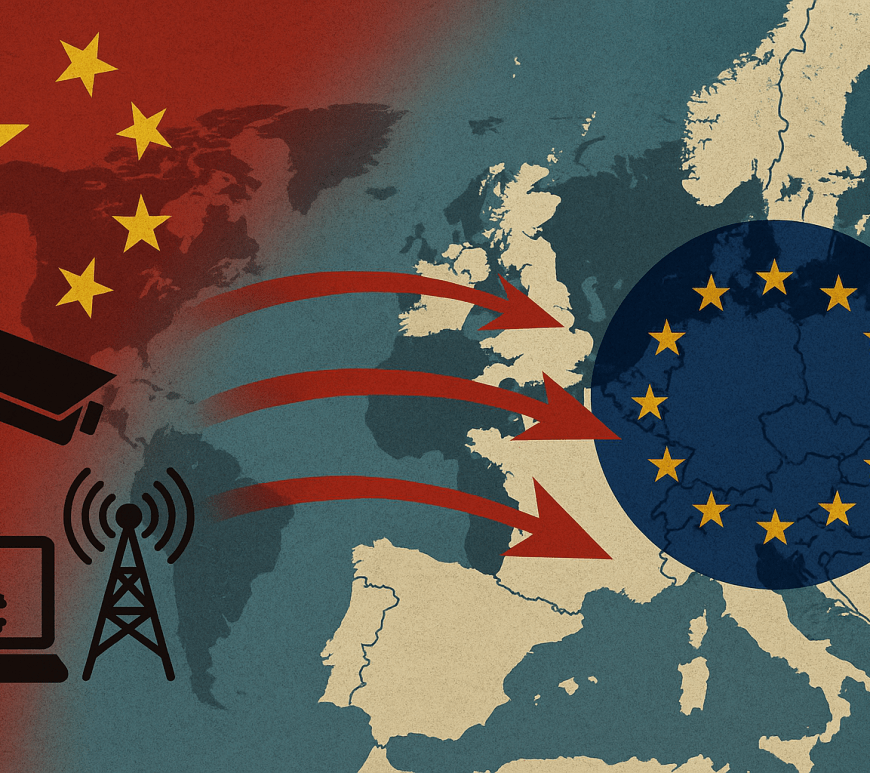
Hybrid Threats „with Chinese Characteristics“ – The PRC’s Hybrid influence in the EU

“To fight and conquer in all your battles is not supreme excellence; supreme excellence consists in breaking the enemy’s resistance without fighting.”
— Sun Tzu, The Art of War

This oft-cited maxim not only encapsulates centuries of Chinese strategic thinking but also prefigures a modern concept increasingly relevant in global security discourse: hybrid threats. Coined by Frank G. Hoffman in 2005, the term refers to a form of warfare blending conventional and unconventional tactics, state and non-state actors, and overt and covert strategies—often remaining below the threshold of open conflict.

As Europe grapples with this evolving threat landscape, the People’s Republic of China (PRC) emerges as a particularly complex actor. This article explores how “hybrid threats with Chinese characteristics” manifest in the EU context and how China strategically exploits political and economic levers to erode cohesion and assert influence.
Hybrid Threats „with Chinese Characteristics“ – The PRC’s Hybrid influence in the EU weiterlesen

The “eclectidology” of Putin’s Russia: The ideological underpinnings of Russia’s neo-imperialism

Tomorrow, Thursday, 15 May 2025, another round of “peace negotiations” may take place in Istanbul. Following the visit of British Prime Minister Keir Starmer, French President Emmanuel Macron, German Chancellor Friedrich Merz, and Polish Prime Minister Donald Tusk, a joint statement was issued calling for a 30-day unconditional ceasefire — a proposal originally put forward by President Trump. This initiative aimed to lay the groundwork for genuine peace talks. However, the Kremlin responded with yet another deflection strategy, proposing a round of sham negotiations in Istanbul.

Ukrainian President Volodymyr Zelenskyy called the Kremlin’s bluff by announcing his readiness to negotiate personally with President Putin — an offer the latter predictably declined, as acknowledging Zelenskyy would imply recognition of his legitimacy, which the Kremlin officially denies. A decisive obstacle to any lasting peace is the ideological underpinning of Russia’s foreign policy — a worldview shaped over 25 years of Putin’s rule, which continues to fuel Moscow’s neo-imperialist agenda, particularly in what it considers its “near abroad.”

So what is the underlying justification and ideology of the Kremlin and Russia’s imperialism to justify its full-scale invasion of a smaller neighbor violating international law? The “eclectidology” of Putin’s Russia: The ideological underpinnings of Russia’s neo-imperialism weiterlesen

Opinion: US Elections – Global Impact and the Future of (Transatlantic) Multilateralism

The US Votes – The Whole World Watches and Will Act Accordingly In the coming hours and days, as polling stations close and the world once again focuses on the United States, some things are already abundantly clear. First, this election is somewhat of a “Schicksalswahl” (a choice of fate) not only for American society but also for the West in general. This election may … Opinion: US Elections – Global Impact and the Future of (Transatlantic) Multilateralism weiterlesen

Russia in the Bear Trap? An analysis of The Russian Military Capabilities

Before Russia’s war of attrition against Ukraine, Russia’s army was described as the second strongest in the world, behind the United States. It was assumed that a comprehensive modernisation of the armed forces had taken place after the Georgian war in 2008 and the shortcomings that emerged there. And the hybrid form of Russian warfare, also known as the „Gerasmiov Doctrine“ was notorious. Especially after the annexation of Crimea in 2014, which was contrary to international law, a connection of meaning between Gerasimov’s speech from 2013 and Russian actions in Ukraine was made retrospectively. This happened in several countries, but to different degrees. What is common, however, is that the fighting power of the Russian army – both in the classical sense and in terms of its hybrid capacities – was generally overestimated. Some analysts predicted that Kyiv would probably fall in three days. Almost a year after the start of Russia’s war of aggression against Ukraine, which violated international law, one can thus ask the question: What does Russia’s power potential look like today? Russia in the Bear Trap? An analysis of The Russian Military Capabilities weiterlesen

Brazil – US comparisons. How the presidential system almost plunged a country into political chaos. Again.

The result of the Brazilian election was eagerly awaited around the world. Many commentaries drew a comparison to the 2020 US election. Why the comparison to the US presidential election falls short and yet says a lot about the current state of presidential systems. Brazil – US comparisons. How the presidential system almost plunged a country into political chaos. Again. weiterlesen

From successful broker to a client state? Russia-Belarus relations amongst the backdrop of the war in Ukraine

Russia’s Relations with Belarus has been quite paradoxical in the past. Lukaschenko has been proven himself as a sucessfull broker between east and west. But the latest developments in Belarus as well as Russia’s war against Ukraine seemed to have shifted this dynamic. From successful broker to a client state? Russia-Belarus relations amongst the backdrop of the war in Ukraine weiterlesen